How to wash the outside of a house the safe way: the right pressure for stucco, paint and siding, the order to work in, and the mistakes that push water behind your walls.
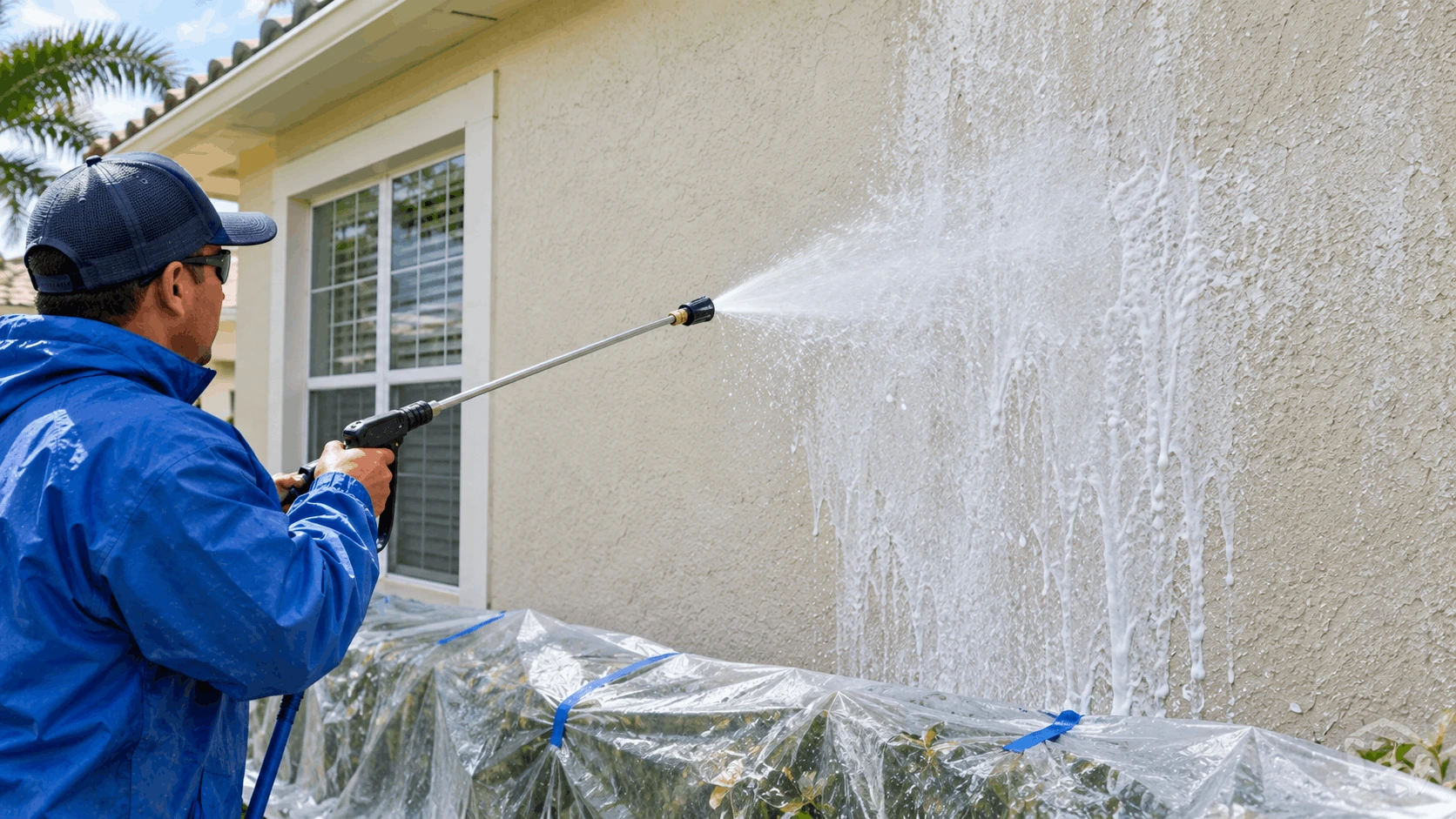
To pressure wash a house safely, use low pressure (well under 1,500 PSI) with a wide 25 or 40-degree nozzle or, better, soft wash it with a cleaning solution. Close windows, protect plants and outlets, wet the wall, apply detergent from the bottom up, let it dwell, then rinse from the top down. Never aim the spray upward under siding or at windows, doors and light fixtures. Stucco, painted walls and two-story homes are usually best left to a professional.
Most South Florida houses are stucco or painted block, which is far more delicate than people expect.A dirty house rarely looks dirty until you wash one wall. Then you notice the whole home has faded to a tired gray-green, and the clean patch looks like a different paint color. It is one of the most satisfying jobs in home care, and one of the easiest to get wrong.
We wash houses across Broward and Palm Beach counties every week, and we get called to a lot of homes where a well-meaning owner used a driveway setting on stucco. This guide covers how to pressure wash a house properly, what pressure each surface can take, and the honest line between a good DIY weekend and a job for a professional. If you would rather skip straight to help, see our house washing services.
Half of a good house wash happens before the machine is switched on. Water pressure finds every gap in a house, so preparation protects both the exterior and the inside.
The biggest mistake we see is treating a house like a driveway. Walls are thinner, more porous and sealed in different ways. The table shows the range we work in as a starting point, and a good technician always adjusts to the condition in front of them.
| Surface | Recommended method | Typical pressure | Watch out for |
|---|---|---|---|
| Stucco | Soft wash with detergent | Low; rinse gently | Gouging, water pushed behind the wall |
| Painted block or wood | Soft wash, low-pressure rinse | Low | Peeling paint, lead paint on older homes |
| Vinyl siding | Soft wash or gentle pressure wash | Low to moderate | Water forced behind the laps |
| Brick | Low-pressure wash, no narrow tips | Low to moderate | Mortar joints eroding |
| Aluminum siding | Gentle wash | Low | Dents, oxidation marks |
| Windows, screens, light fixtures | Do not blast; rinse gently | Very low | Seals, broken glass, torn screens |
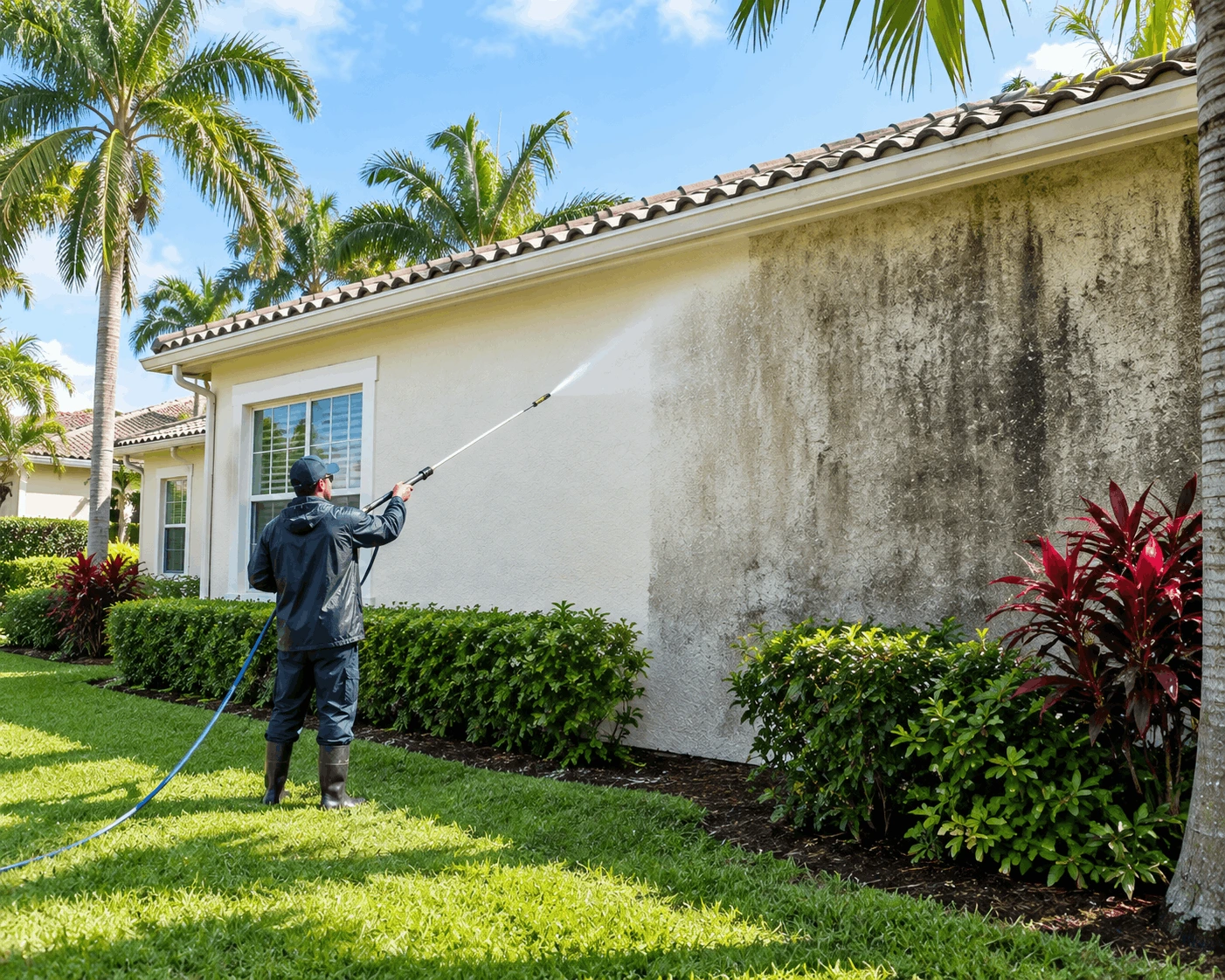
This is the order that works for us, whether the house is a small one-story or a larger two-story home.
Lightly wet walls and landscaping first, so the cleaner does not soak in unevenly or burn plants.
Working bottom to top, apply a house-wash detergent at low pressure so it does not streak, then leave it to dwell.
Use a 25 or 40-degree nozzle, keep the wand angled slightly downward and stay at least a couple of feet from the wall.
Rinse from the roofline down to the ground and flush landscaping again. Check for missed spots while the wall is still wet.
Never spray upward into siding, eaves or soffits. On lap siding the water is forced behind the boards, and in a hurricane-rated house that moisture ends up somewhere you cannot see it. And never let cleaner dry on the wall. Work in sections that you can rinse before the solution dries, especially on a hot day.
Two-story homes deserve their own warning. Ladders and pressure washers are a poor mix, because the wand kicks and water reflects. If you cannot reach the upper wall from the ground with an extension wand, that is the moment to book a professional.
Pressure washing relies on force. Soft washing relies on a cleaning solution, usually a mix based on sodium hypochlorite with a surfactant, applied at low pressure and given time to kill algae, mildew and spores at the root. On stucco and painted walls, soft washing gets the walls cleaner and lasts longer, and it does not put the surface at risk. We explain the differences in detail in our comparison of soft washing, pressure washing and power washing, and if you are dealing with green or black growth, see mold, mildew and algae on your home.
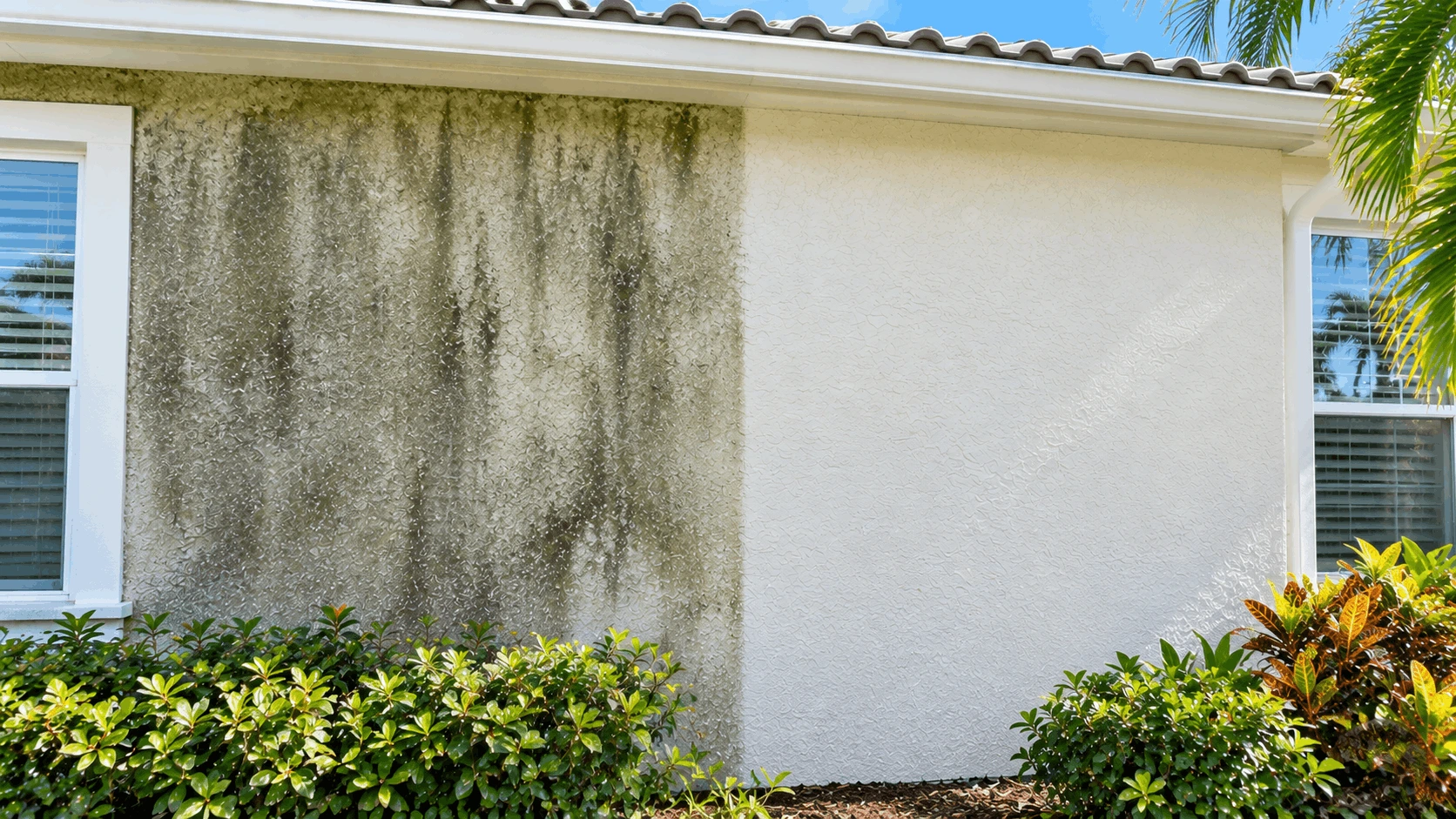
In our climate, algae and mildew build up quickly, especially on the shaded north side, near sprinklers and under trees. Many homes look best with a wash about once a year, and shady or humid properties sometimes need it sooner. Our full breakdown is in how often you should pressure wash your house.
There is no shame in handing this one over. It is the outdoor job with the most ways to cause expensive damage. Here is when we suggest calling in a crew.
These need low-pressure soft washing and the right chemistry to avoid staining or moisture problems.
Extension poles, ladders and roof access add risk and require experience.
Thick algae, black mildew and rust take specific products and dwell time.
Loose paint, cracked stucco and old caulk need an expert to spot before washing.
A proper wash before listing or repainting helps the finish look better and last longer.
A crew usually washes a whole house in a fraction of a weekend.
For an idea of what goes into a quote, read our guide to pressure washing prices in South Florida, or send us photos through our free quote page for a clear answer.
Washing your house is not about power. It is about matching the method to the surface, protecting what is around it and taking your time. Get that right and the result is a home that looks freshly painted for the price of a wash. If you would like an expert to do it, we would be glad to help.

We restore driveways, roofs, patios, pool decks and commercial properties across South Florida from our base in Sunrise, FL. Free, no-obligation quotes: call (954) 405-6642 or request a quote online.
Send us your address and a few photos. We will come back with a clear, no-obligation price.
Request a Free QuoteCall (954) 405-6642WhatsApp UsServing Sunrise, Plantation, Pompano Beach, Fort Lauderdale, Deerfield Beach and nearby cities.Send us your address and a couple of photos. We will tell you the safest method for your walls and give you a clear price in writing, free and with no obligation.